Blip Desk App
Our initial goal was to have an app with the same functionalities across both platforms, as well as to match the features of the Web version, so that we could later release new functionalities for specific user groups.
We previously had a WebView app available, which only supported Android users. When the Flutter squad was formed, we began working on iOS as well. This allowed us to launch the beta version for iOS. The beta was shared with internal users and selected companies for testing.
We were able to sunset the WebView version and officially release the first store version built with Flutter, using Material Design components.
By the start of Q3 2023, our main Key Result was to reach 20k active users on the app. Our key metric for measuring adoption was the number of active users, which was tracked from the first ticket responded to in the app.
In less than three months, we brought nearly 10,000 unique users to the platform, with over 5,000 activated users. These 10,000 users handled 100,000 tickets through the app.
We worked as a cross-functional team across Design, Product and Marketing to define a launch strategy with multiple initiatives happening simultaneously – including push notifications, email campaigns, blog content, social media posts and new features aimed at retaining our users.


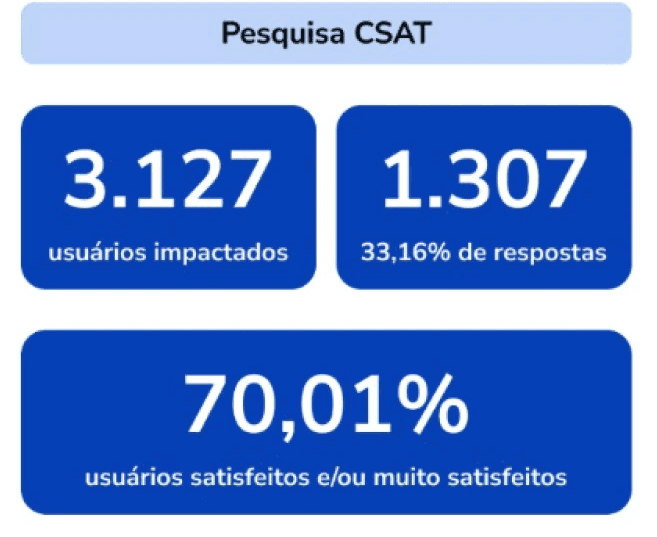
With the goal of better understanding our users’ needs and establishing a baseline for future product improvements, we achieved outstanding results with our first Satisfaction Survey.
We reached a 95% confidence level in relation to the impacted user population, considering a 5% margin of error.
By clustering the results, we created a Pain Point Ranking. The most frequently mentioned issues among our users were related to media handling, slowness, notifications, tags and the support experience itself.
Our Key Result for Q3/23 was to activate 20,000 users through the app. To achieve this, we implemented several initiatives and strategies, one of which was user engagement through notifications.
We used the AppCues platform to deliver personalized in-app messages with media content, audience targeting and defined display periods. Simultaneously, we sent push notifications via Firebase to re-engage and warm up our users.

Takeaways
Within the Desk product, we identified three main personas. Since the app’s launch, we believed one of them would be the primary user of this product. However, despite targeting this persona through multiple strategies, we were unable to reach the goal of activating 20,000 users — a Key Result set for the quarter. This led us to hypothesize that either this persona is not our true target, or perhaps it doesn’t exist as we initially thought.
While we couldn’t directly prove that the user activations were a direct result of our strategies, we observed a positive impact on the overall numbers.
In one AppCues post alone, we reached 40,000 users on the Web platform within a week. Still, even with multiple posts and initiatives, it wasn’t enough. The users impacted on the Web version are not necessarily the same as those using the app, and most companies don’t provide mobile access to their teams. We also noticed from the notification launches that the most impacted audience consisted of small businesses — which, although they showed high engagement, contributed fewer users overall when compared to large enterprises.
Next steps
Identify the actual target audience and their needs through user research.
Conduct interviews with CSAT survey respondents in stages — starting with detractors, then promoters and finally exploring improvements with neutral users.
Define new strategies to drive adoption of the app among large companies.