How could we offer healthcare services remotely while ensuring efficiency, effectiveness and safety?
Additionally, how could we integrate them with in-person services that are returning to normal?
After the onset of the COVID-19 pandemic, people began avoiding leaving their homes, going to crowded places, and consequently stopped visiting hospitals and clinics.
This behavior led to another problem: health conditions that already have established treatments began to be neglected. Serious illnesses such as cancer and heart attacks were no longer treated with the urgency they require. Even HIV treatments started to be abandoned due to fear of COVID-19 contamination.
We began the immersion process with a desk research to better understand the problems and the current context of the challenge. We searched for and gathered information on the topic, with our main sources being news articles and journalistic reports.
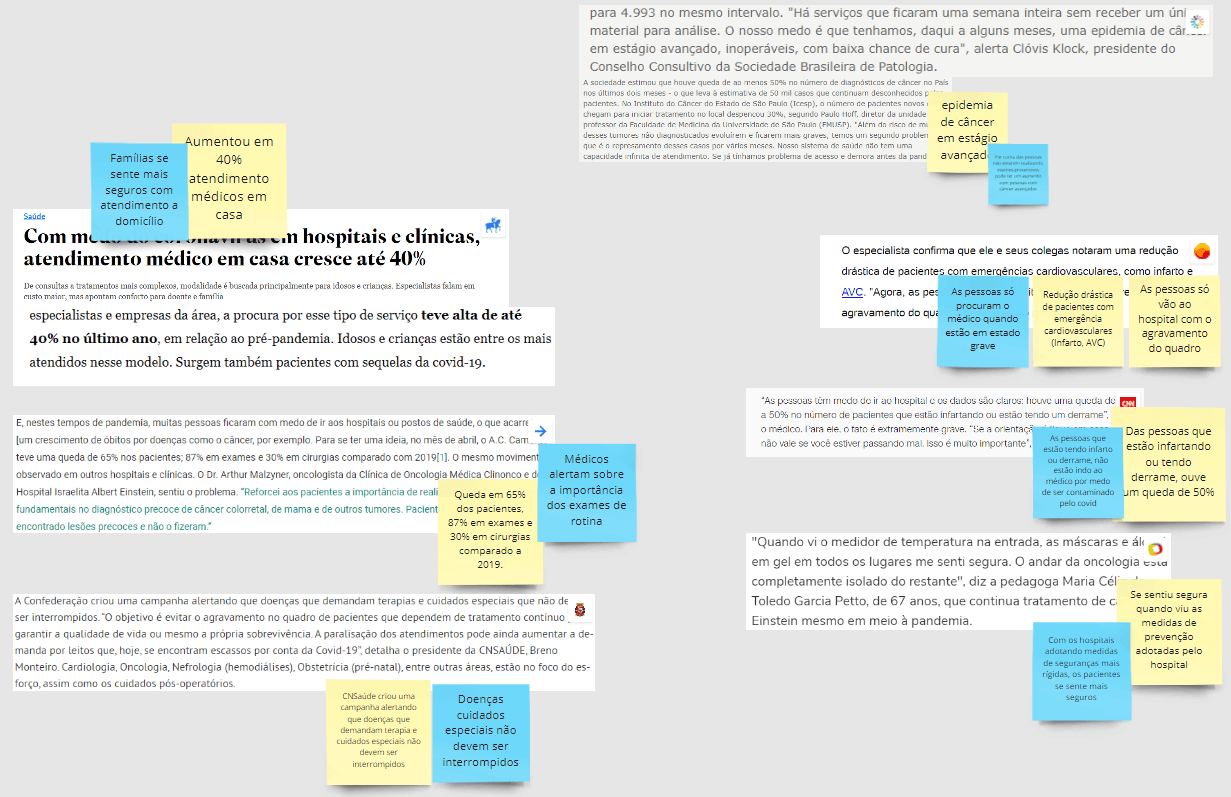
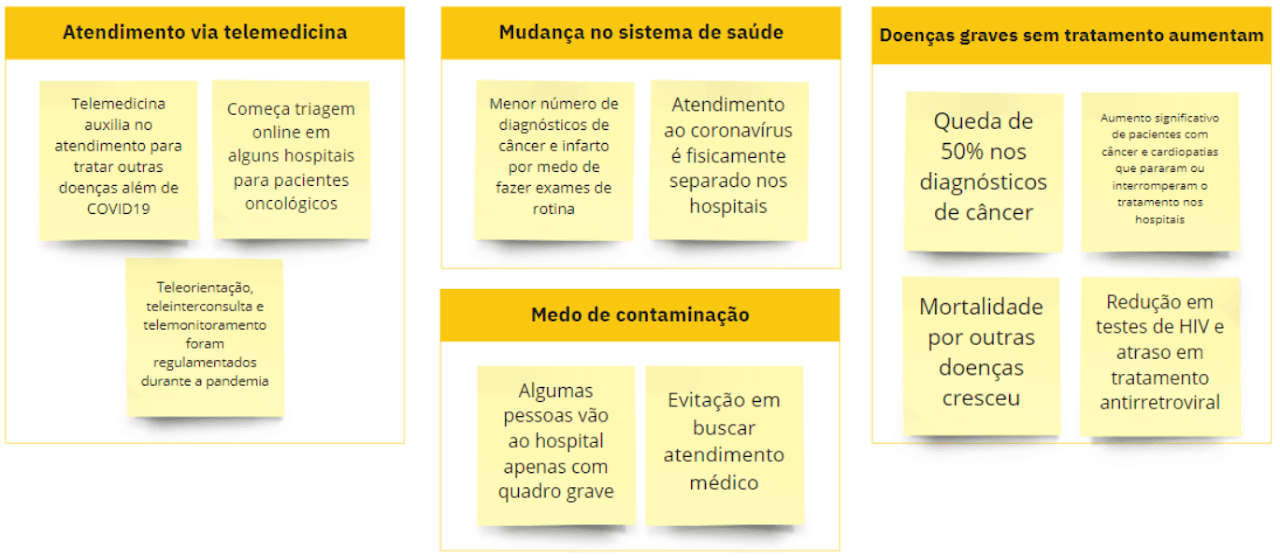
This process led to the creation of a CSD matrix: certainties, suppositions and doubts.
Certainties
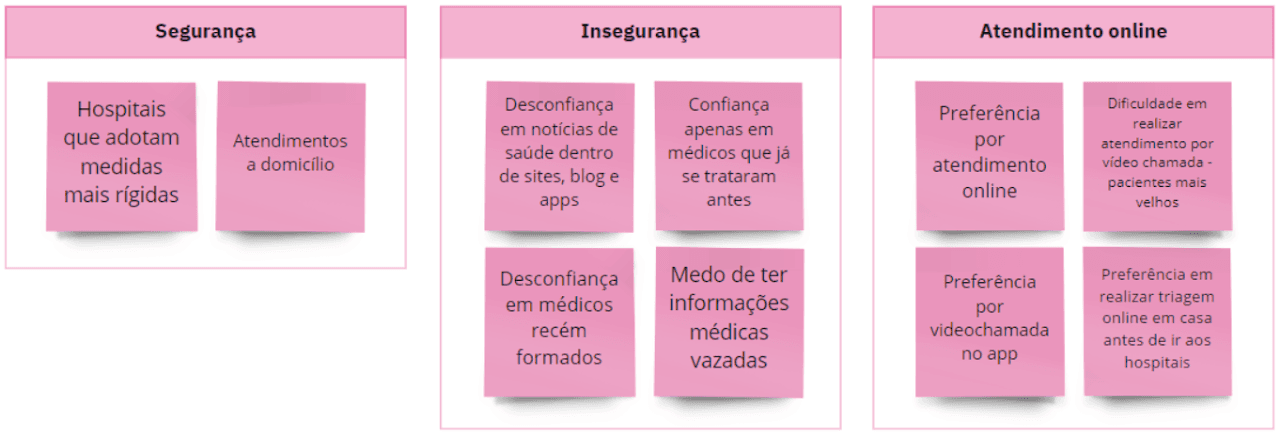
Doubts

Our business goal was to facilitate and speed up the scheduling of medical appointments and exams for people who are afraid to visit hospitals or clinics, thereby reducing physical contact between patients.
Based on the desk research, persona creation and user interviews, we identified several common user needs:
A platform that is easy to use and understand;
Home care services and online consultations;
A reliable source of information;
A way to keep their medical appointments organized.
During the pandemic, people reduced their visits to hospitals and health clinics due to fear of COVID-19 contamination. As a result, they started using health apps to schedule appointments—whether in-person, at home, or via video call.
Based on these observations, we developed an app focused on user needs, such as being able to have an online consultation, access exam results, or even receive reminders for upcoming appointments.
Observing the pain points and desires of our personas, we decided to create an impact vs. effort matrix, prioritizing solutions that would have a high impact on users while requiring low effort from the team.
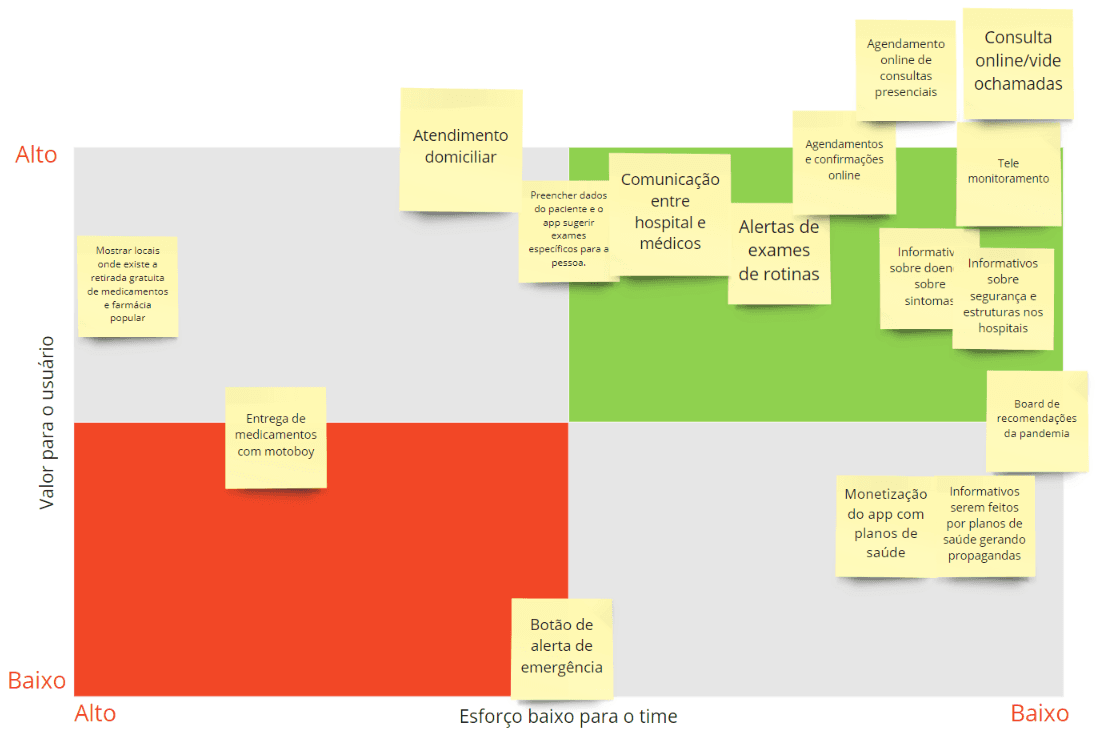
Many ideas were placed in the high-value, low-effort quadrant. Therefore, we decided to reallocate the solutions and apply the matrix again, reprioritizing and arriving at the following result:

It was understood that the solutions to be implemented in the future app would include:
Online consultations/video calls;
Online scheduling of both in-person and online appointments;
Routine exam alerts.
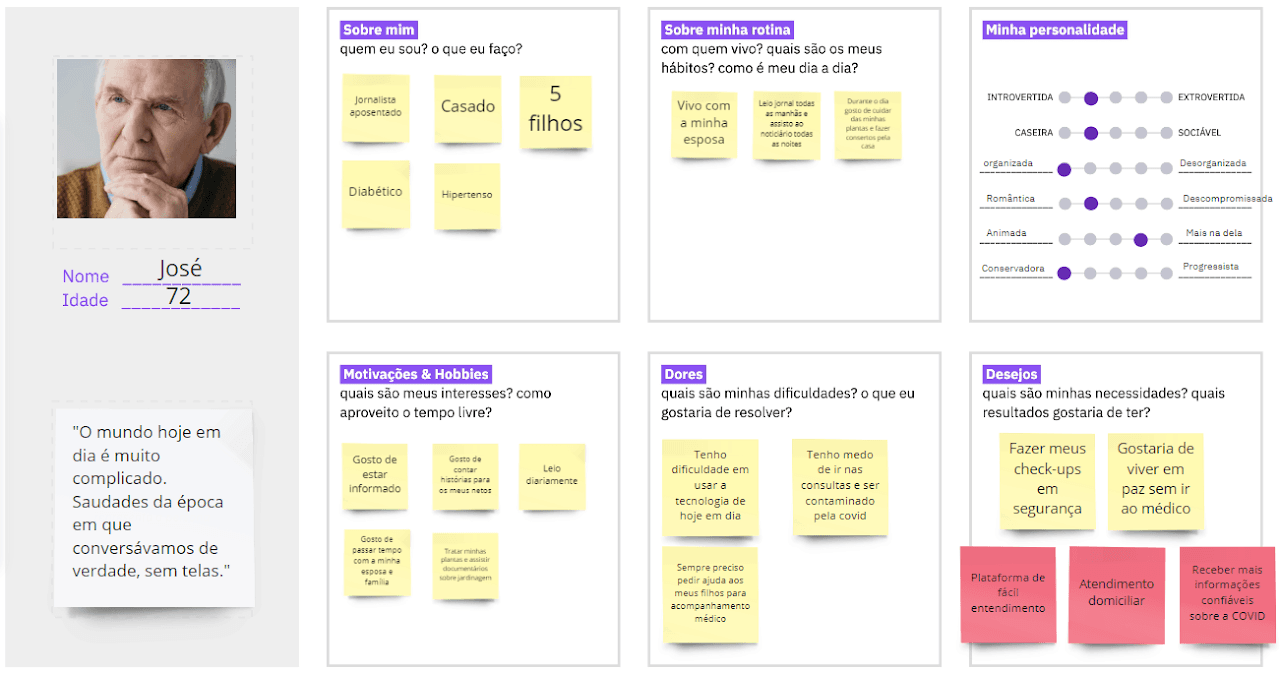
José's storytelling
Our first proto-persona is José, a 72-year-old retired journalist. José is married and has five children. He lives with his wife and manages diabetes and hypertension. Currently, José spends his days tending to his plants and doing repairs around the house. Whenever possible, he spends time with his wife and grandchildren. Every morning, he reads his newspaper, and every evening, he watches the news.
"The world nowadays is very complicated. I miss the times when we really talked, without screens."
Although he reads daily and likes to stay informed, José does not hide his passion for gardening documentaries. He struggles a lot with technology these days and is also very afraid of going to medical appointments and being exposed to the virus. For these reasons, he constantly needs to ask his children for help with medical follow-ups and many other technological tasks.
José wishes there was more accessible technology that would deliver truthful news, without so many lies spreading along the way. He hates having to ask for help with such simple tasks. It would also be very helpful for him to be able to do his routine exams safely from home.
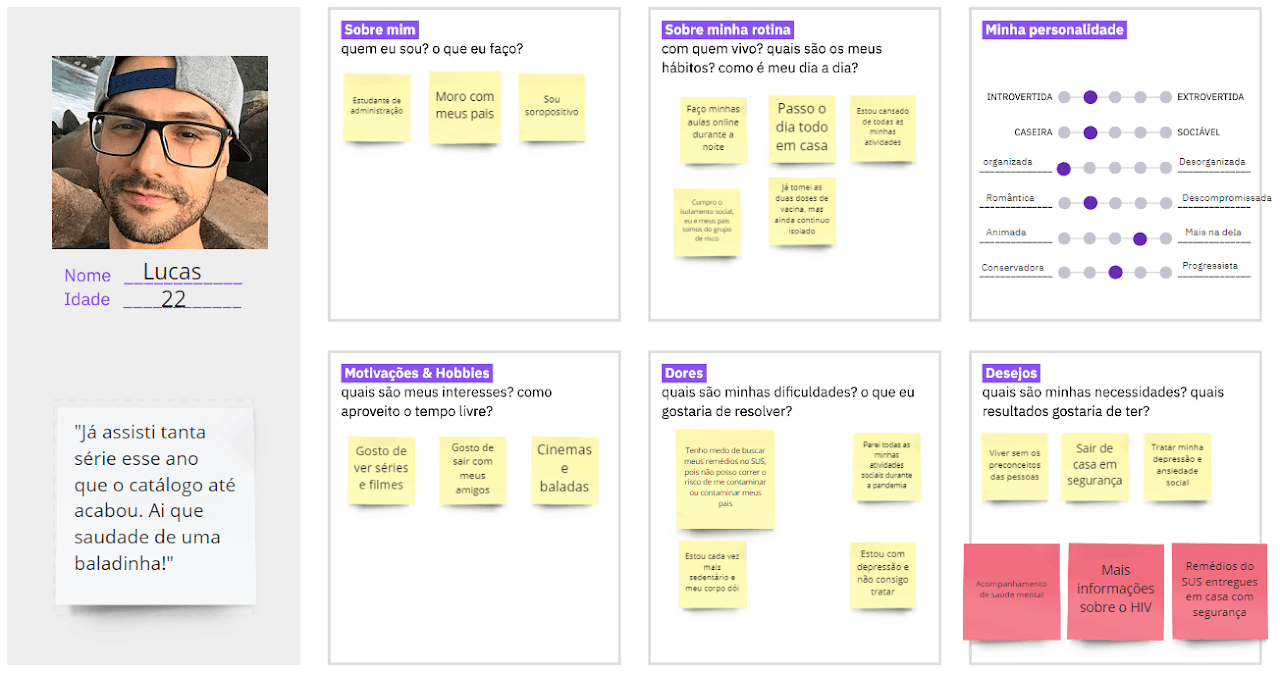
Lucas' storytelling
Lucas, 22 years old, represents our second proto-persona. Lucas is a business administration student who lives with his parents and is HIV-positive. He currently spends the entire day at home and attends his classes remotely in the evenings via the internet. Although he has received both doses of the vaccine, Lucas is still afraid to leave the house and remains isolated with his parents, as they all belong to risk groups. Before the pandemic, Lucas enjoyed going out with friends, going to the movies, and partying. Nowadays, he has replaced those activities with watching series and movies but is already tired of the same old routine.
"I've watched so many series this year that the entire catalog is almost gone. Oh, how I miss going out to a party!"
Lucas’s situation worsens when he has to pick up his medications from the public health system (SUS), which increases his usual fear, as he cannot risk exposing himself or his parents to contamination. Due to halting his social activities during the pandemic, Lucas has become increasingly sedentary and already experiences body aches. For many reasons, he has fallen into depression and doesn’t know how to seek treatment.
Lucas dreams of a world where he doesn’t have to live with prejudice. It would be incredible to be able to treat his depression and social anxiety, so he can safely leave the house again without so many worries.
Bruno's storytelling
Here is our third proto-persona, Bruno, 32 years old. Bruno is a cardiologist. He currently works at a clinic during the day and at two hospitals, also doing emergency shifts when needed. He lives with his fiancée, Luiza, and their dog, Belchior, and loves spending time with them. Cooking is his therapy, especially when paired with a beer and some guitar playing to wind down. When he has more free time, he enjoys cycling, although that has been a rare activity lately.
"I really wish I had more time to relax with my fiancée and not worry so much about work commitments…"
Bruno is a bit disorganized, which makes it hard for him to manage his schedule for patients, shifts, and personal or leisure activities. As a result, he doesn’t have much time for fun or to take care of his own health. In fact, his gym membership has been paid for months, but he can count on one hand the number of times he’s actually worked out.
His current goal is to finish paying off his apartment, and to achieve that, he needs something to help him organize his work schedule effectively. The next step is to have a baby when he finds some free time — which will soon be completely occupied by the little one.

Scenario: The user needs to schedule an appointment to manage their diabetes. The user dislikes going to the hospital and is not familiar with technology, but their doctor is registered on an app.

After the immersion and research phase, we moved on to the definition stage. Focusing on simplifying the scheduling of medical appointments, we concluded that the best solution would be a mobile app. Our solution was strongly influenced by the brief, which suggested an app as the answer to the problem.
Choosing a mobile app made sense given the users' needs, and it also provided easy access for a large part of the population.
We began developing our idea with a low-fidelity wireframe. The flow was designed so users could view available dates and doctors without needing to have an account in the app.

Still in the definition phase, based on desk research, surveys and interviews, we reached the following conclusion: users needed to undergo routine exams to prevent the worsening of certain illnesses.
In the following account, we hear from an interviewee who was diagnosed with breast cancer after going a year without her routine exams during the pandemic.
"In 2020, I was afraid to go to my appointments to get my annual routine exams. When I finally went in 2021, I was surprised with a breast cancer diagnosis."
User interview
Since our questionnaire focused on patients, we decided to interview a staff member at a Basic Health Unit (UBS) to understand the perspective of doctors and administration.
Our interviewee, Gisele, works as an administrative assistant at the UBS. After the pandemic, she took on additional roles, including working at the reception. Several employees were retired or dismissed, with no plans for replacements.
Gisele serves around 30,000 patients, and appointment and exam hours were reduced due to COVID-19 vaccination efforts.
Currently, the system is overloaded, and there is a waiting list of 2 to 3 months for scheduling.
The interviewee reports that many of these problems stem from current administration and could be resolved internally with better organization.
At the UBS, scheduling exams and appointments is only possible in person. Phone calls and WhatsApp are used solely for general inquiries.
When asked about a possible digital solution, Gisele said she wasn’t sure if it would be a good idea for patients, since many people feel the need to go to the location in person, as a way to maintain social relationships or even for leisure.
Gisele mentioned that the most time-consuming task in her routine is scheduling appointments, as the system is inadequate and she needs to enter patient data across multiple different platforms. She added that an integrated online health system would be a great solution to these problems.
Regarding safety and compliance with health regulations, Gisele said there isn’t enough material available to guarantee the safety of all UBS patients.
Questionnaire
Our questionnaire targeted a relatively broad audience:
People who undergo medical consultations, exams, and treatments;
People who stopped performing these activities during the pandemic.
Hypotheses we wanted to address:
Patients do not trust screenings conducted by virtual assistants.
They do not undergo routine exams annually.
They do not organize themselves to carry out routine exams.
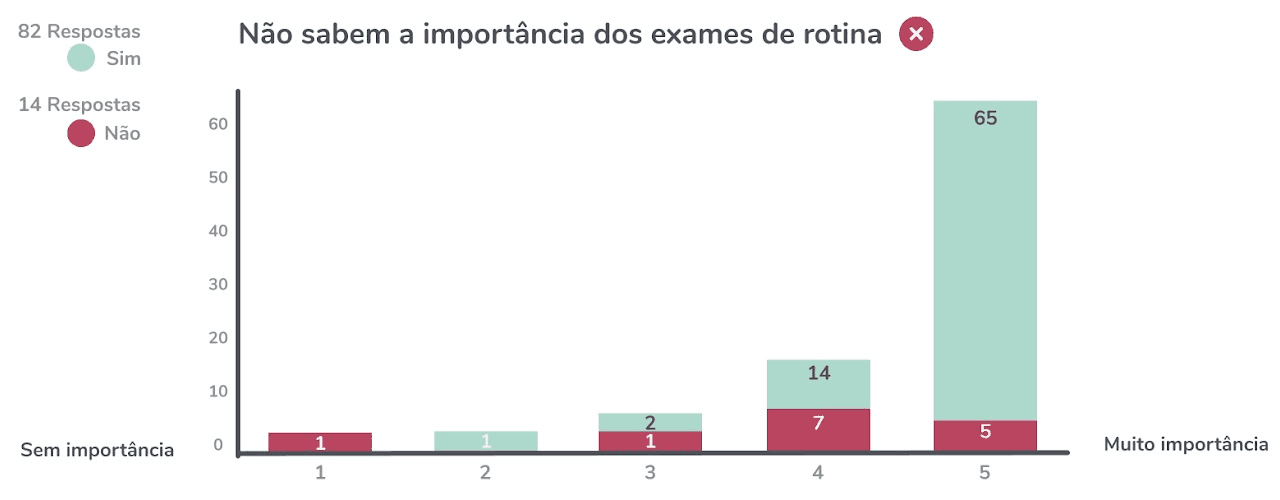
They are unaware of the importance of routine exams.
They have doubts about which exams they should undergo.
Our questionnaire aimed to answer:
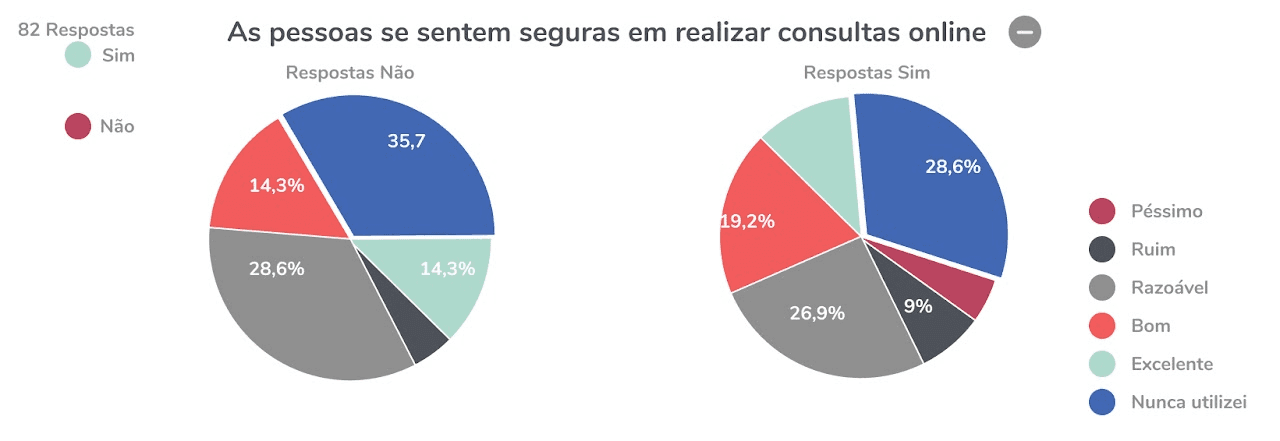
Do people feel safe having online consultations?
Do people feel secure entering medical data into the app?
How are online scheduling processes working for in-person appointments?
At the end of this questionnaire, we expected to have a list of problems and recommendations to guide the development of our solution.
Some of the obtained results
Despite news reports that many people stopped visiting doctors, 85.4% of our users did not abandon their health routines.

The majority of respondents understand the importance of routine medical exams.
Although many people have not yet used online consultation services, a large portion believes it is a positive service.
The green rectangles highlight the app’s positive aspects, while the red rectangles indicate the negative points.

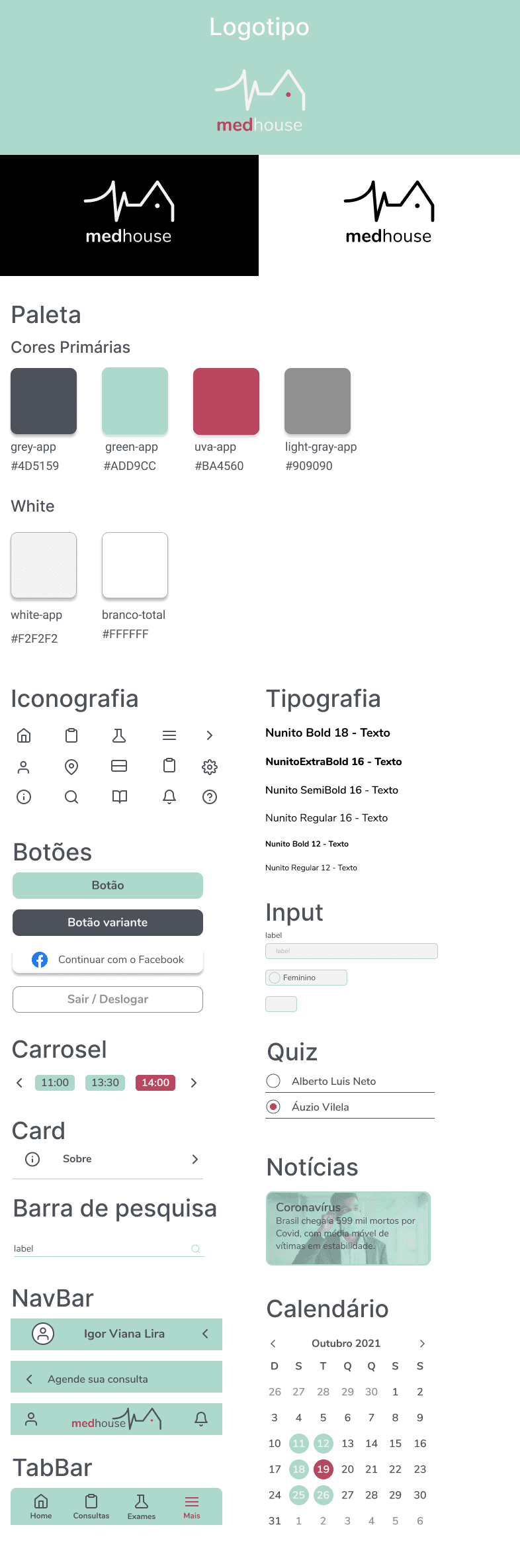
We believe the pandemic context calls for some calm. Based on Eva Heller’s book The Psychology of Colors, we created a style guide featuring soothing colors.
The app uses a 60:30:10 color ratio. We combined proportions of green, blue, and some white to form the dominant color and chose shades of gray along with an accent color that fit the desired calming effect.
Another key consideration was visual accessibility, both in color contrast and color blindness support. For typography, we selected the Nunito font because of its rounded shapes and easy readability.
The app’s name refers to medical care at home, which is also reflected in its logo: a heartbeat line forming the letter "M" that flows into a house shape.
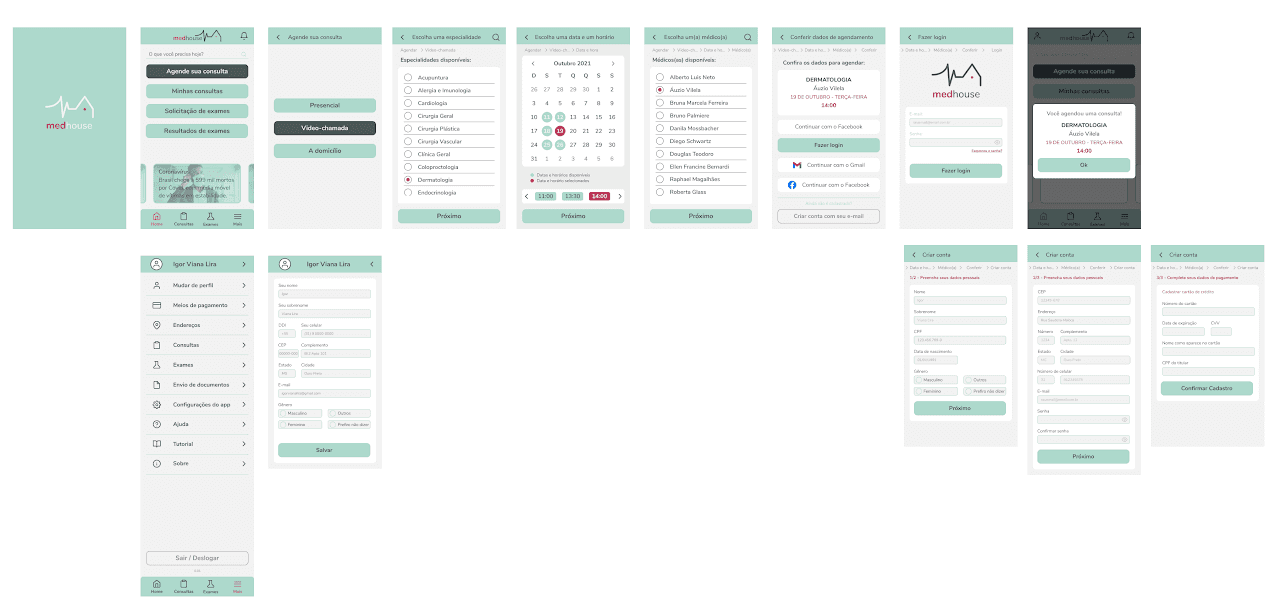
The challenge, based on a real problem—from understanding to completion, grounded in user needs—is an extremely demanding yet rewarding process.
Beyond UX processes, we can affirm that knowledge from other areas contributed significantly to the project.
From our studies, we devised a solution that could address a specific problem for a segment of our users. Every decision was made thoughtfully, focusing on providing the best experience for that user.
There was no time to validate the idea through usability testing, so that will be our first improvement step. We also aim to complete all other app flows to deliver a comprehensive product.
From the initial idea to the final product, the entire process was enriching for the team, allowing us to enhance both our hard skills (process knowledge, research, software use, etc.) and soft skills (teamwork, communication, listening, debating, etc.).
We extend our sincere thanks to all the instructors who guided us throughout these four weeks, the entire Usemobile team, and everyone who mobilized to make this bootcamp possible.
Case study conducted by: